
Pitt County State Prison Releases
No adult North Carolina Department of Adult Correction prison was identified as physically located in Pitt County. That fact does not make state records less relevant. A person convicted in Pitt can be assigned to a prison elsewhere in North Carolina. When that person leaves state confinement, NCDAC may record Pitt as the county to which the person was released.
Release county is a destination field. It is not necessarily the county of conviction, and it does not identify the county where the prison stood. This distinction matters because a Pitt-coded result can come from any NCDAC prison. It also prevents a false claim that Pitt County contains an adult state institution. Search the statewide system first for a former state prisoner, then use the individual profile to confirm the sentence and movement.
Search North Carolina State Prison Releases
The NCDAC Inmate Releases search is the released-first route. It accepts a county with year and month, or a surname and starting characters. Pitt appears as release-county code 74. The form also includes options for a release county not reported and releases to other states.
- Open the dedicated Inmate Releases search before the ordinary offender profile search.
- Select Pitt as the release county, then choose the relevant year and month. Use surname searching when the destination or month is uncertain.
- Match the offender number and full name. Compare the listed release date, primary offense, and release type.
- Open the detailed OPI profile. Verify identity with offender number, birth information, sentence, and county history rather than name alone.
- Read Actual Release Date, Last Movement, Last Movement Date, and Inmate Status together.
- Read Probation/Parole/Post Release Status separately to determine whether state community supervision remains active.
The monthly result identifies releases from state prison. It does not populate a Pitt County jail release list. Someone who only bonded out of Pitt County Detention Center may never enter NCDAC data. For an unknown custody system, the Pitt County released inmate search explains how to separate local, state, federal, and immigration records.
Note: The release county describes NCDAC's recorded destination, not the prison location or necessarily the county that entered the conviction.
NCDAC State Prison Release Fields
The Pitt monthly result provides a compact released-person index. It can show offender number, last name, first name, middle name, release date, primary offense with qualifier, and type of release. Observed types included expiration and parole or return to parole. Each row should be opened because the short result cannot show every sentence period or current supervision status.
| Field | How to read it |
|---|---|
| Offender Number | The strongest identifier for linking the release row to the OPI profile. |
| Full name | A starting match that still needs birth and sentence details. |
| Release Date | The date on the released-first result; reconcile it with the detailed actual date and movement. |
| Primary Offense | The primary listed offense and qualifier, not a complete sentence history. |
| Type Of Release | The state label for the event, such as expiration or a parole-related movement. |
| Release County | The destination county recorded by NCDAC, not a prison or conviction county label. |
When observed on July 30, 2026, the release-search year selector showed 2024 through 2026. That is a three-calendar-year interface observation, not a statutory retention period. Ordinary OPI has historical information generally back to 1972, and older release basics may also be requested from NCDAC.
Read State Prison Release Details
The ordinary NCDAC OPI search provides the detailed record. A seven-digit offender number is the best input. Name searching can be paired with an exact birth date or an allowed age range, and the form offers a Sounds Like surname option. Keep Offender Status at All when current status is uncertain. Inactive can help narrow a person believed to have completed state custody or supervision.
Open the matched profile and read Inmate Status apart from Probation/Parole/Post Release Status. An inactive incarceration with an actual release date and matching last movement supports departure from state prison. Active supervision means the person remains subject to state conditions after physical release. Inactive in both top-level fields is stronger evidence that neither NCDAC imprisonment nor NCDAC community supervision is active, but it does not rule out a new county, federal, or immigration custody event.
The NCDAC criminal-offender searches directory sets out the scope of the state tools. Its captured page below is a useful entry point when a direct OPI link changes or a different state status search is needed.
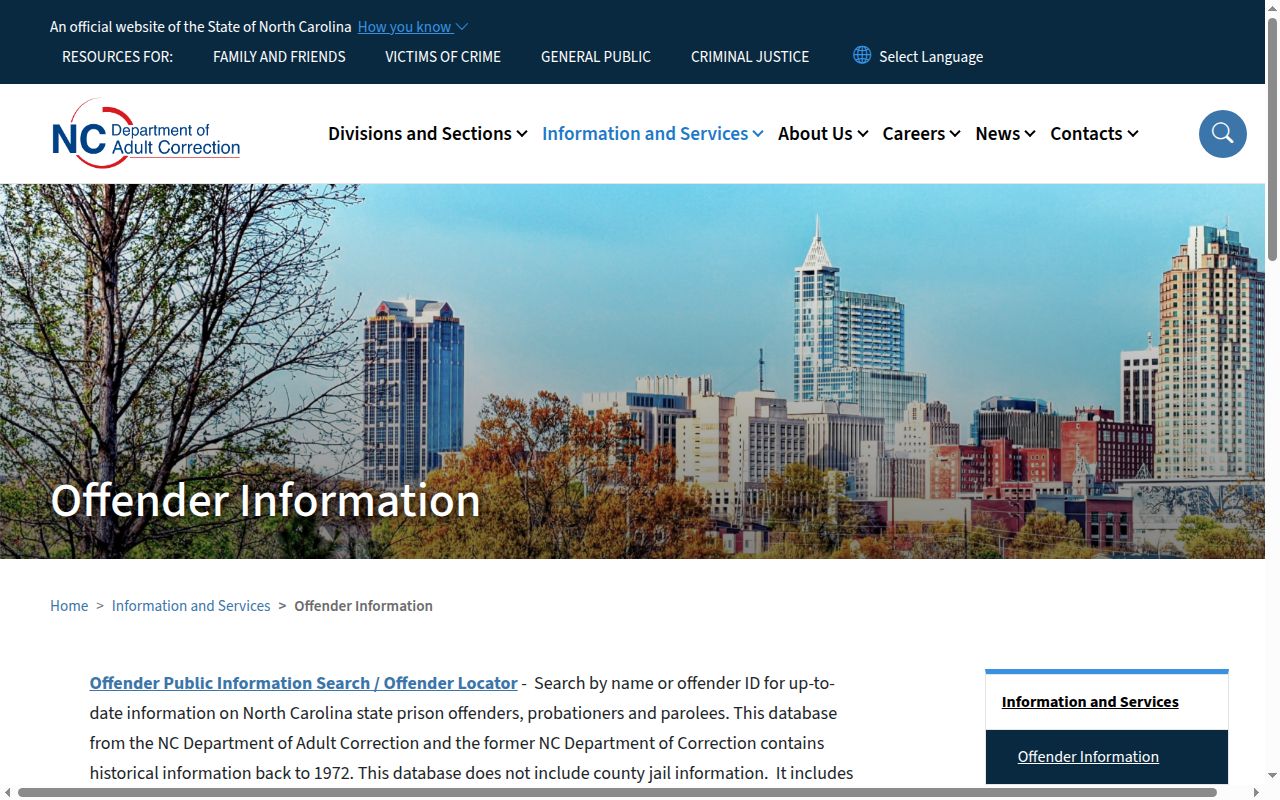
The directory routes state correction records. It does not cover a PCDC-only stay, a federal sentence, or juvenile detention.
Actual State Prison Release Dates
Projected Release Date is NCDAC's estimate of a possible prison-release point based on the judgment, minimum and maximum sentence structure, earned-time accounting, and later events. It is not the completed event. A projected date can remain visible within historical sentence lines even after an actual date is recorded. For a completed North Carolina state-prison sentence, lead with Actual Release Date and confirm Service Status, Last Movement, and Last Movement Date.
A projected date can change after earned-time awards or forfeitures, sentence correction, aggregation of concurrent or consecutive terms, a new judgment, revocation, escape, return, or recalculation. Multiple commitments can produce more than one projected or actual date. Read every relevant sentence line rather than lifting one date from the summary.
| Date or status | Meaning |
|---|---|
| Projected Release Date | An estimate that may change and may remain in old sentence history. |
| Actual Release Date | The completed state-custody date for the matched sentence period. |
| Last Movement and date | The latest recorded prison movement and its date. |
| Inmate Status | Whether state imprisonment is active or inactive. |
| Supervision Status | Whether probation, parole, or post-release supervision continues. |
Note: Actual Release Date is stronger for a completed sentence, but all sentence periods and the latest movement still require reconciliation.
North Carolina State Prison Timing
North Carolina Structured Sentencing uses minimum and maximum terms. Under G.S. 15A-1340.13(d), active punishment generally requires service of the minimum term, subject to the statute's Advanced Supervised Release provision, while earned credit may reduce the maximum but ordinarily not below the minimum. NCDAC's shorthand of all the minimum and at least 85 percent of the maximum is not a direction to multiply one undifferentiated sentence by .85.
G.S. 148-13 directs the Secretary to establish earned-time rates and the circumstances for earning or forfeiting credit. The statute does not publish one universal current days-per-month figure for every person. No unsourced calculator can account for the judgment, credits, holds, sentence corrections, or later movement.
Post-release supervision, often shortened to PRS, is calculated under a separate statute. It follows physical prison release for covered sentences. A person can therefore have an actual release date from confinement while the state supervision field remains active. Parole applies to eligible sentence structures and also means release from prison under continuing conditions, not a complete discharge.
State Prison Supervision After Release
OPI's two top-level status fields prevent a common Pitt County error. Inmate Status answers whether state imprisonment is active. Probation/Parole/Post Release Status answers whether state community supervision is active. The second does not mean the person remains incarcerated. It means the person has left confinement but has continuing state conditions.
If Pitt is the county of supervision, the NCDAC Community Supervision directory identifies a Greenville office at 502 B Dexter Street, Greenville, NC 27834, with telephone 252-756-5472. The directory date in the research was July 15, 2024, so verify the office listing before relying on it. That office can route a proper supervision inquiry subject to confidentiality. It is not an open public case-file counter.
- Post-release supervision
- Community supervision that follows release from prison for covered North Carolina sentences.
- Parole
- Conditional release from confinement under the rules for an eligible sentence.
- Probation
- Court-ordered community supervision that can exist without a state-prison release.
- Discharge
- The recorded end of the state custody or supervision obligation being reviewed.
State Prison Versus Pitt Jail Release
NCDAC expressly excludes county-jail information from OPI. Absence from OPI cannot answer whether someone posted bond or served a short sentence at Pitt County Detention Center. The county's current detainee application likewise cannot confirm a release from a state prison elsewhere. The two systems should be checked separately and never merged into one recent-release list.
A person missing from the Pitt roster who appears as an active NCDAC inmate was transferred into state custody. That is not release to the community. Build the chronology from PCDC's departure field and NCDAC's admission or movement. If the NCDAC result later shows expiration with an actual date and inactive supervision, it supports completion of that state sentence, while any unrelated county, federal, or immigration custody still requires a separate source.
Request NCDAC State Prison Release Records
When OPI does not supply enough detail, use the NCDAC public-records channel. Identify the person by full name and offender number. Ask for existing public admission and release basics tied to the relevant sentence, such as conviction information, time served, sentence length, and admission or release dates. NCDAC says it maintains records for people who served in its prisons or participated in state supervision, not local jail records.
Most correctional and supervision files remain confidential even though certain basics are public. A precise request should seek public fields and allow protected content to remain withheld or redacted. NCDAC notes that simple requests may take days, while complex or redaction-heavy requests can take weeks or months. Do not promise a fixed response date or a complete internal file.
The official public-record rules are captured below from the same NCDAC source. They clarify the boundary between available basics and confidential correction records.
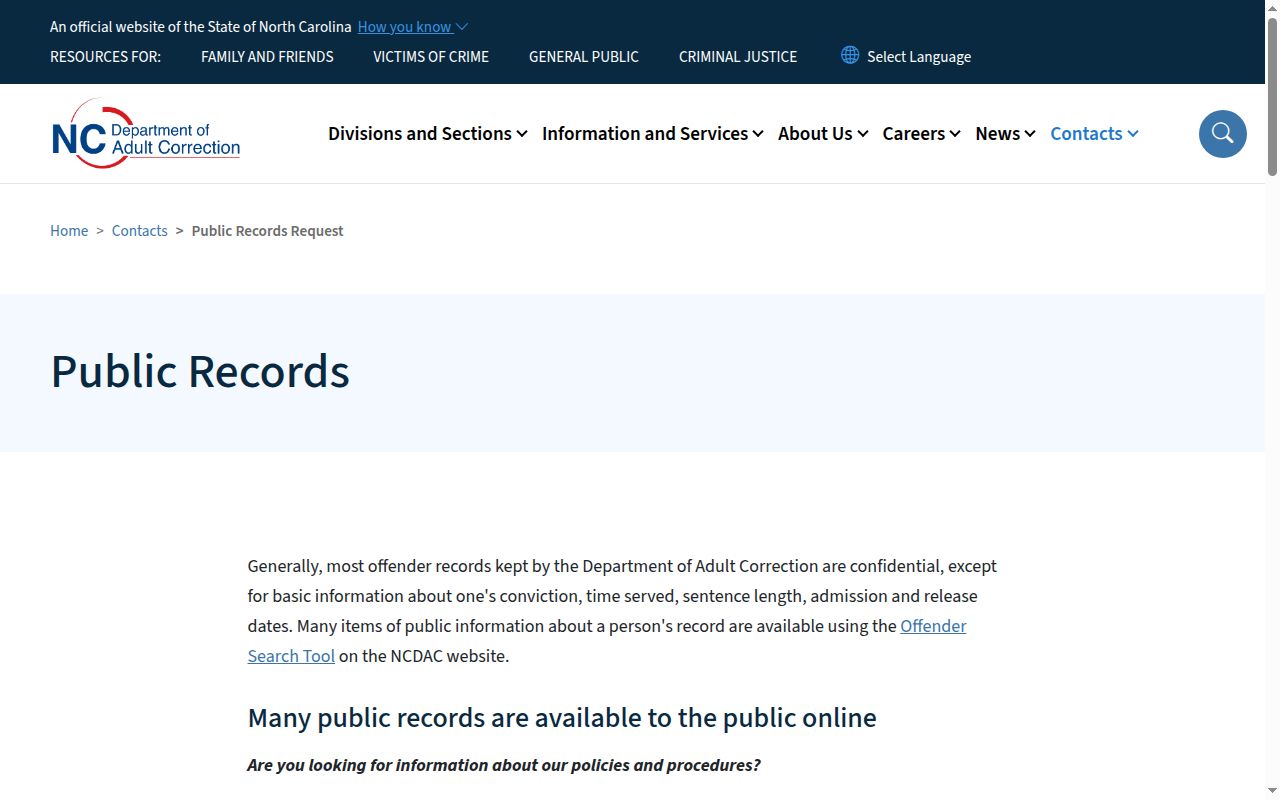
Use the request channel only for the state portion of the custody history. A Pitt court judgment comes from the Clerk, and a PCDC release record comes from the Sheriff's Office.