
Pitt County Projected Release Meaning
Projected Release Date is the exact label used in North Carolina Department of Adult Correction Offender Public Information. It is an estimate based on the judgment, the sentence structure, earned-time accounting, and later events recorded by NCDAC. It is not the same field as Actual Release Date. A projected date may stay in an older sentence line even after the person has left prison. That makes the whole profile more useful than one date read in isolation.
For a completed state sentence, compare the projected date with Service Status, Actual Release Date, Last Movement, Last Movement Date, location, and each sentence period. An active Probation/Parole/Post Release Status can continue after Inmate Status becomes inactive. That combination means physical prison release occurred, but community supervision remains. A new local, federal, or immigration custody event may also sit outside the NCDAC profile.
Match Pitt County Release Custody
Start with the system that holds or sentenced the person. Pitt County Detention Center is the adult local jail. Its official detainee application, current detainees only, shows charge, sentence, and bond information and refreshes hourly. It does not advertise a projected-release calculator or a historical released-person archive. A person awaiting trial may leave after bond conditions or a court order are satisfied, but there is no fixed sentence endpoint to calculate in the same way as a prison term.
A person serving a North Carolina prison sentence belongs in NCDAC OPI, even if the conviction was in Pitt or the recorded release destination is Pitt County. No adult state prison was identified inside Pitt County. Federal sentences belong in the BOP locator, and immigration custody belongs in ICE's system. A PCDC departure to NCDAC, another jail, ICE, or the U.S. Marshals Service is a transfer. It must not be described as unrestricted release merely because the person left the county roster.
| Custody situation | Best date source | Key limit |
|---|---|---|
| Pitt pretrial detention | PCDC and the Pitt court case | Bond or an order is not a fixed release timestamp. |
| Pitt local sentence | PCDC record and court judgment | No verified public Pitt calculator or universal earned-time rate. |
| North Carolina prison | NCDAC OPI sentence profile | Projected and actual dates must be reconciled across all terms. |
| Federal sentence | BOP Inmate Locator | A future date is projected and BOP release does not end all supervision. |
Find Pitt County Projected Dates
Use the seven-digit offender number when it is known. It is a stronger NCDAC key than a name alone. The ordinary OPI form also accepts name, sex, race, ethnicity, age, and birth-date criteria, including a date range and a surname Sounds Like choice. Leave status at All when the current state is uncertain. Choosing only Active Inmate can hide a person who has already left prison but still has a historical sentence profile.
- Open the NCDAC Offender Public Information search.
- Enter the offender number, or search by name with birth and identity details. Do not match on name alone.
- Open the correct person and read Inmate Status separately from Probation/Parole/Post Release Status.
- Review the Most Recent Incarceration Summary, Projected Release Date, Actual Release Date, Last Movement, location, and sentence history.
- Reconcile concurrent or consecutive periods and any later return before stating which projected date controls.
If the person has already completed state confinement, the NCDAC Inmate Releases search can be a faster first path. Search Pitt as release county with a year and month, or use surname criteria. Its result date is for a state-prison release recorded to Pitt, not a Pitt jail release and not proof that the prison was in Pitt County.
Note: Use an offender number, birth detail, and sentence history to separate people who have similar names in state records.
Pitt Release Minimums and Maximums
North Carolina Structured Sentencing uses a minimum term and a maximum term. Under G.S. 15A-1340.13(d), a person with active punishment must serve the minimum term, apart from the statute's Advanced Supervised Release provision. Earned credits may reduce time against the maximum but ordinarily cannot take confinement below the imposed minimum. The judgment is therefore the starting record, while NCDAC's computation is the operational state record.
G.S. 148-13 directs the Secretary to establish rules for earning and forfeiting credit, and it requires applicable rules for sentenced local-jail prisoners to be distributed to jail administrators. The statute does not provide one universal current days-per-month rate for every Pitt County case. Sentence class, controlling law, awards, forfeitures, aggregation, and administrative records all matter. A public calculator that assumes one rate would conceal those differences.
The Structured Sentencing minimum-term statute shows the legal floor that must be read before any estimate.
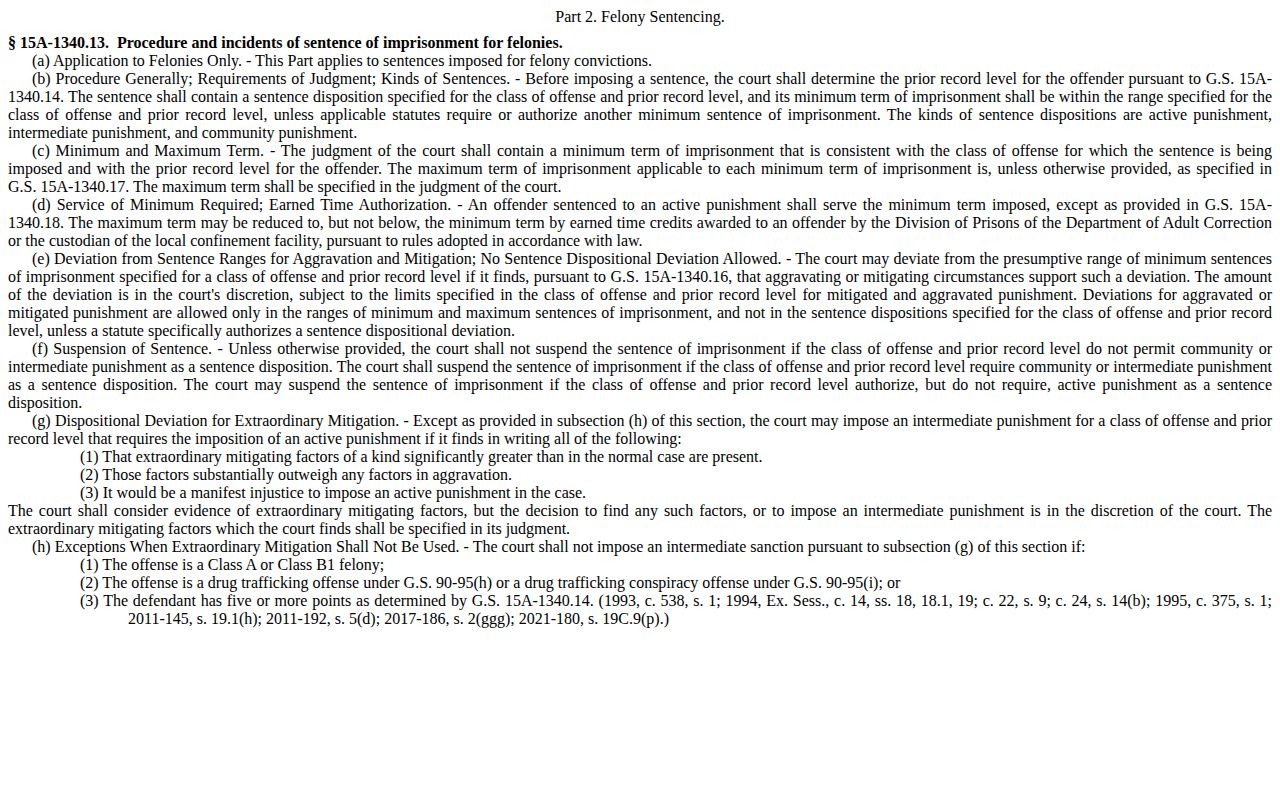
The statute explains why earned time is not a free-standing shortcut below the imposed minimum term.
Why Pitt Release Is Not 85%
NCDAC describes Structured Sentencing as requiring service of 100 percent of the minimum and at least 85 percent of the maximum. The “85%” phrase is shorthand for that minimum-and-maximum system. It is not a universal instruction to multiply one sentence by 0.85. A North Carolina judgment imposes a range, earned time operates within that range, and the release to post-release supervision is calculated under a separate statute.
G.S. 15A-1368.2 generally sets release to post-release supervision at the maximum term minus 12 months for Class B1 through E and minus nine months for Class F through I, with earned time included in the calculation. Specified sentences use a 60-month subtraction, and registration-triggering offenses carry five years of supervision. The law in effect for the offense and sentence must be applied to the actual record.
Post-release supervision is a community portion of the sentence, not prison confinement and not full discharge. Credit during supervision may reduce its original length only within the statutory limit. Revocation or return can produce another prison movement and later date. The current OPI profile is needed because a category taken from the primary offense alone may not reflect every sentence period or later event.
Pitt Projected Release Date Changes
A projected date changes when the inputs or legal record change. NCDAC can update earned-time accounting. A sentence may be corrected, aggregated with another term, or affected by a revocation and return. A detainer can keep someone in a different agency's custody even after the NCDAC confinement point. These changes are not all visible in the same field, which is why date, status, movement, and sentence lines must be read together.
| Factor | Possible effect on the release account |
|---|---|
| Earned-time award | May reduce time against the maximum within the governing minimum-term rule. |
| Credit forfeiture | May move the projected prison-release point later under applicable rules. |
| Sentence correction | Can change the minimum, maximum, credit, or controlling sentence history. |
| Concurrent or consecutive terms | Can alter which aggregated period controls the date shown. |
| Revocation or return | Can create a new movement, confinement period, and later release event. |
| Another agency's hold | Can turn departure from one custodian into transfer rather than community release. |
Parole eligibility is another distinct concept. It mainly concerns older sentencing law, because crimes committed on or after October 1, 1994 generally use Structured Sentencing and post-release supervision rather than ordinary parole. A first eligibility date is not a promise of release. The North Carolina Post-Release Supervision and Parole Commission controls eligible parole review, while NCDAC records the resulting custody and supervision movements.
Pitt County Jail Release Dates
Pitt County publishes no verified local release-date calculator and no universal jail earned-time rate. For a person serving a local sentence, request the existing commitment and calculation data through the Pitt County Detention Center and obtain the judgment from the Pitt County Clerk of Superior Court. Ask for the admission date, court credit, sentence, recorded release date or projected endpoint if maintained, and any transfer field. An agency need not create a new calculation or narrative that it does not keep.
For a pretrial detainee, use the court order and PCDC record for different facts. A bond order states legal conditions. It does not prove the full bond was posted, all holds cleared, or jail processing ended at the order time. A dismissal in one case does not clear another case. The Sheriff publishes Inmate Information at 252-902-2868 during regular business hours and after-hours or holiday help at 252-902-2913. Ask a narrow question tied to the booking number and case.
- Projected release date
- The custodian's current estimate based on the sentence record and credited events.
- Actual release date
- The date the responsible system records the completed departure event.
- Detainer
- A request or hold tied to another agency that may affect what happens after one custody ends.
- Post-release supervision
- The supervised community phase that follows prison for covered North Carolina sentences.
Note: Pitt County has no verified routine release hour, public exit schedule, or local date calculator to substitute for agency records.
Confirm Pitt County Actual Release
Once the projected date passes, stop treating it as the best field. For an NCDAC sentence, compare Actual Release Date, Last Movement, Service Status, and separate supervision status. A release type such as expiration with inactive supervision strongly supports completion of that state term, but it cannot rule out an unrelated county, federal, or immigration event. A parole or return-to-parole release with active supervision means the person left prison while state oversight continues.
For a Pitt jail event, confirm the physical departure with PCDC and the legal authority through the North Carolina court Portal or Pitt court file. The Pitt County release search and records overview covers the named-person chain without treating roster absence as a reason code. If an alert is useful while a date remains pending, the Pitt County VINELink check explains how to select one record and enroll. VINELink is an agency-fed alert, not a certified release document.
Keep an as-of date with each screen or oral confirmation. Note the agency, unit, identifier, public field, and time checked. A written release record or court order is preferable when durable proof is needed. Current status can change after a valid historic release, and a projected date can remain visible after the actual event. Clear dates and source labels keep those two facts from being collapsed.
Pitt State Release and Discharge
A state-prison release recorded to Pitt County may come from a prison anywhere in North Carolina. The dedicated monthly NCDAC Inmate Releases tool identifies Pitt as release county code 74. Its result fields include offender number, name, release date, primary offense, and type of release. “Release county” is the recorded destination. It is not the prison county and may not be the conviction county.
The ordinary OPI profile then supplies the needed depth. An inactive incarceration line with an actual date and matching movement is evidence of exit from state prison. Active supervision means the state correction relationship continues in the community. Inactive prison and supervision fields give stronger support for discharge from both statuses, though another jurisdiction still requires its own check. This two-stage review is more accurate than copying the first date from a monthly result.
G.S. 148-13 contains one further statewide rule that must stay in its proper scope: a prisoner discharged or paroled after at least two years of incarceration shall receive at least $45. It is a state-prison provision, not a Pitt County jail payment promise and not part of the projected-date calculation. The distinction shows why a state statute cannot be imported wholesale into a local jail release account.